Single Instance Store Explained for Smarter Data Storage

Data duplication is one of those technology problems that grows quietly. A file gets copied into several folders, an email attachment reaches hundreds of employees, and multiple backup jobs preserve the same information again and again. Everything still appears to work, yet storage consumption rises, searches become cluttered, and administrators have more copies to secure, track, retain, and eventually delete.
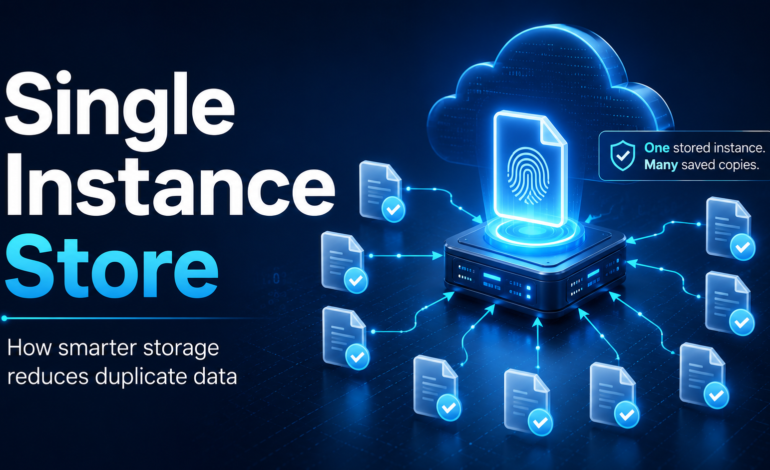
A single instance store addresses that waste by keeping one authoritative copy of identical content and allowing users, applications, or backup sets to reference it. The idea is simple, but the way it affects storage capacity, recovery, legal retention, security, and system design deserves a closer look.
For businesses, this is not merely a trick for saving disk space. It can help create a cleaner information environment in which duplicated content is easier to control. At the same time, it introduces dependencies that must be protected carefully. Understanding both sides makes it easier to decide where the technology belongs and when a more advanced deduplication system may be the better choice.
What Is Single Instance Storage
Single instance storage, commonly shortened to SIS, is a data management method that identifies completely identical files, messages, or other objects and stores only one physical copy. Other locations that appear to contain the same object are connected to the stored copy through logical references or pointers.
Imagine that a company sends a 5 MB benefits handbook to 500 employees. A conventional archive could preserve hundreds of separate copies of the attachment. An SIS-enabled archive can retain one copy while maintaining the mailbox, recipient, timestamp, permissions, and policy information needed for every employee’s record. Users still see the attachment where they expect it, even though the underlying data is not physically repeated.
This transparency matters. From the user’s perspective, each folder, mailbox, or backup snapshot can look complete. Behind the scenes, the system maps duplicate items to a protected common store. Microsoft describes its earlier SIS technology as a predecessor to modern Windows Data Deduplication. It identified entirely identical files and replaced redundant copies with links to one shared version. mes used loosely. Traditional SIS generally works at the whole-file or whole-object level, meaning two items must be identical before one can replace the other. Newer deduplication tools may divide data into smaller chunks and remove repeated sections even when the complete files differ.
How a Single Instance Store Works
The process usually begins when a storage or archiving platform examines incoming or existing data. It compares objects using content signatures, hashes, checksums, file attributes, or a combination of methods. A reliable platform verifies the actual content rather than assuming that matching filenames represent identical files.
When the platform confirms a match, it keeps one physical copy in a central repository. Additional copies are replaced by references pointing to that object. The system also preserves metadata showing where each logical copy belongs, who may access it, how long it must be retained, and whether it is protected by a legal hold.
A simplified process looks like this:
- The system receives or scans a file, email, or backup object.
- It calculates an identifier based on the content.
- It checks whether the same object is already stored.
- If there is no match, it saves the new object.
- If a match exists, it creates a reference instead of another full copy.
- When a user requests the item, the system follows the reference and presents the content normally.
Deletion requires careful handling. Removing one user’s logical copy must not destroy the shared object while another valid reference still depends on it. Systems commonly use reference counts or comparable controls. The physical object can be deleted only after all relevant references, legal holds, and retention obligations have ended.
Backups provide an easy example. Suppose a server contains 100 GB of files and creates a full backup every day. If only 2 GB changes between runs, the repository can reuse links to unchanged files and store mainly the new or modified data.
Several snapshots may appear to consume far more space in a file browser than they physically occupy. That happens because the browser may count every visible file in each backup set, even though unchanged files are linked rather than copied again. ns Use SIS
The most visible advantage is reduced storage consumption. Email systems, shared drives, document repositories, software libraries, and backup environments often contain large numbers of identical objects. Avoiding unnecessary copies can delay storage upgrades and reduce the amount of data sent to secondary locations.
Lower physical data volume may also mean shorter backup windows, less replication traffic, fewer objects to scan, and reduced cloud storage charges. Results depend heavily on the workload. A repository filled with repeated templates and attachments may benefit greatly, while a collection of unique videos may produce limited savings.
SIS can also strengthen information governance. When an archive maintains one underlying object with well-managed references, administrators gain a clearer view of where the information appears and which policies apply to it.
Records retention is a good example. A company may need to preserve a document for a specific number of years before deleting it. When unnecessary copies are scattered across multiple systems, different versions may receive inconsistent retention settings. One copy could be deleted too early, while another remains long after it should have been removed.
A controlled archive can connect separate retention instructions and legal holds to the same stored object. This helps administrators determine whether a file may be deleted, must remain available for litigation, or is still required under an internal policy. Retention, defensible deletion, legal holds, and chain of custody are therefore important governance benefits associated with SIS. e:
- Email archives containing repeated messages and attachments
- Backup snapshots in which most files remain unchanged
- Shared repositories holding duplicate forms, media, installers, or reports
- Records management systems that preserve one object with separate metadata
- Software deployment environments containing identical packages
- Cloud storage platforms seeking to control redundant capacity
There can be a search and investigation benefit as well. Deduplicating physical content does not necessarily remove every repeated search result because logical records may have different owners, dates, or retention rules.
However, a well-designed archive can index the underlying object while retaining its relationships to multiple users and locations. That arrangement can make auditing and eDiscovery more manageable without stripping away important context.
SIS Compared With Deduplication Compression, on and Backup
SIS and data deduplication are closely related, but they are not always interchangeable. Traditional SIS compares complete objects. If two 100 MB files are identical, one can be stored and the other referenced. If only a few bytes differ, both may need to be stored in full.
Block-level or chunk-level deduplication goes deeper. It divides files into smaller sections and searches for repeated chunks. Two documents can therefore share stored blocks even when the complete files are not identical.
Modern data deduplication succeeded traditional SIS in many Windows storage environments and can achieve greater efficiency through subfile chunking and compression. s a different type of repetition. It reduces redundancy within a file or stream by encoding it more efficiently. Deduplication removes repeated content across files, users, devices, or backup sets.
For example, compressing 20 identical documents could make every document smaller, but the system would still have 20 copies. Deduplicating them would keep one copy and replace the remaining 19 with references. Many storage systems combine both approaches by removing duplicate content first and then compressing the data that remains.
Most importantly, storage optimization is not the same as backup. If hundreds of references point to one physical object and that object becomes corrupted, deleted, encrypted by ransomware, or otherwise unavailable, every linked copy may fail.
Organizations still need protected backups, tested restoration procedures, access controls, monitoring, and independent recovery copies. Keeping a second copy in the same system may improve availability, but it does not necessarily protect against software errors, account compromise, or ransomware that can reach both locations.
The shared model also creates several practical risks:
- Damage to the reference database may disconnect users from otherwise intact content.
- A corrupted shared object can affect every logical copy connected to it.
- Hash matches must be verified to prevent incorrect identification.
- Different retention periods can make deletion more complicated.
- Encrypted or frequently changing files may deliver poor savings.
- Migration may require files to be rehydrated before another platform can use them.
- Reported folder sizes may differ from physical disk usage.
Security must operate at the logical-record level. Sharing one stored object does not mean every user should receive identical access. One employee may be authorized to open a document while another employee has a reference to the same content but lacks the required permissions.
The platform must enforce individual access rights while protecting the common repository with encryption, authentication, audit logs, integrity checks, redundancy, and role-based administration. Email archiving systems using SIS principles also need governance, legal discovery, and policy controls rather than relying on storage savings alone. In technology, an organization should measure how much duplicate data it actually owns, how references are protected, what happens when records expire, and how the complete repository will be restored after a failure. It should also decide whether whole-object SIS is sufficient or whether block-level deduplication better matches the workload.
Frequently Asked Questions
Is single instance storage the same as deduplication?
It is a form of deduplication, but traditional SIS usually removes duplicate whole files or objects. Modern deduplication may also identify repeated blocks within different files.
Does SIS delete users’ files?
No. It normally replaces redundant physical copies with logical references. Users can continue accessing the item while their permissions and references remain valid.
Can SIS replace a backup system?
No. It saves capacity but does not provide complete protection against corruption, ransomware, accidental deletion, hardware failure, or damaged metadata.
Where is this technology most useful?
It works best in email archives, repeated backup snapshots, shared document stores, software repositories, and other environments containing many identical files or attachments.
What happens when one referenced copy is deleted?
The system usually removes that reference only. The physical object remains until no valid references, legal holds, or retention requirements depend on it.
Conclusion
A single instance store turns repeated data into shared data. By preserving one physical copy and connecting each logical occurrence through controlled references, it can reduce storage use, streamline backup operations, and improve information governance.
Its value is strongest where identical files, messages, or attachments appear repeatedly. Still, efficiency should never be mistaken for resilience. The shared object, metadata, permissions, and recovery process all require strong protection.
For modern environments, the right choice may be whole-file SIS, granular data deduplication, or a combination of optimization methods. The best approach depends on the workload, compliance obligations, security model, and the organization’s ability to recover data when something goes wrong.