En Kebab History, Flavours and Its UK Appeal

Meat and fire, that’s a story that comes out fast. The scent of charcoal and the salads freshness, the bread’s warmth all evoke a past and present. Kebab has gone beyond national barriers, adapted itself to native preferences, and become a staple at varied occasions, from intimate family gatherings to late-night kebab shops.
The term en kebab extends on the internet with lots of readers not knowing what it means. It is often mistyped as search words for information about the kebab, in English, as no one name makes up one officially recognised recipe. That curious term conceals a wealth of meaning: the grilled, roasted and spit-cooked foods that constitute a centuries-long heritage of communication and interaction among families.
What is going on in that big frame is important because kebab gets a bum rap from being one thing. In Britain, it could be reminiscent of a döner wrapped in flatbread following a night out. Elsewhere, perhaps it means charcuterie pairing lamb with different cuts around a spit, or meat mince formed into a skewer or on the grill, with chicken and veggies. Every makes reference to a distinct location, technique and dinner tradition.
So, what is the meaning of ‘en kebab’?
It is not a traditional dish per se with two words that are directly combined to form its name. On the internet, the word is usually viewed as an inquiry as to what the term Kebab entails and how it is created, which in turn resulted in the general adoration that it enjoys. The word “kebab” refers to a big family of dishes, and not to any particular recipe.
Kebab is the most basic term used for grilling foods, including meat. There are other versions which use cubes on skewers. Others make use of seasoned minced meat shaped around a long metal stick. Döner is stacked on a vertical spit while today, it can be stuffed with halloumi cheese, mushrooms, aubergine, or veg – another option!
This is how you can get different types of kebabs ordered by the same two people. One might get smoky lamb with rice and herbs and one might get sliced chicken wrapped warm in a spinach wrap with garlic and salad. They both share the same plastic gastrinomy.
A good definition thus starts with flexibility. The thing about kebab is not so much about a single ingredient but the interplay between the seasoning, the heat, and the art of cooking. Best examples are a savoury core with freshness, acidity and texture. Lemon, pickled vegetables or sumac add flavor to rich meat, and bread or rice makes it a meat meal.
Shaped by Travel, Fire and Tradition: A Dish.
There is no single invention story for kebab. Baking meat over an open fire is one of the most ancient ways of preparing food and communities throughout the Middle East, Central Asia, the Mediterranean and South Asia adapted it over time. The methods meet and evolve through trade, migration and empire.
It is associated with the Persian, Arabic and Turkish language of cooking, but dishes of this category come from many cultures. While it all might be in one form or another produced using the same heat and spices, there are definitely differences between Turkish, Greek, and South Asian grilled meats.
The dish lives up thanks to a familiar scene. The meat sizzles and the bread gets toasty, and the grilled meat rotates on the skewers. Simple to explain but difficult to time and execute without denying moisture is the trick to getting tenderness without drying the meat.
Kebab also grew to be social food. Platters of big size could be displayed in the middle of a table sharing the bread, rice, salads, yoghurt and sauces. It was used as a means of stimulating discussion and for everyone to create their own plate to their liking.
As recipes took a journey, they were transformed. The outcome was influenced by the local meat on hand, local spices, religious traditions and preferred breads. In Britain, that’s the background to the kebab scene, which is Turkish, Cypriot, Kurdish, Arab, Greek, Persian, South Asian and so much else, but also influenced by the takeaway culture.
The Secrets to a Memorable Kebab
The downfall of most kebab actually starts before even a barbecue is even lit. Depending on the kind of meat used and the piece’s size and the length of time the meat is marinated, the meat may result in either a tender or a dry texture. Lamb gives richness, chicken gets nicely flavoured by marinades and beef provides more savoury flavour. Minced mixtures should have sufficient fat to keep the mixture moist and firmly attached to the skewer.
There’s no one recipe for marinades but many feature fat, acidity, aromatics and spices. The meat can be marinated with olive oil and/or yoghurt and lemon provides brightness. Lots of garlic, onion, cumin, coriander, paprika, black pepper and chilli often are added, but what is right for regional style. The primary rule of a good marinade is that it’s there to serve the food, not to hide it.
Heat is very important, too. Charcoal has the ability to impart a smoky flavor and produce nice crisp edges, but it requires control. Moving meat too near to intense heat can result in outer flames scorching meat while it is cooking and not reaching the proper internal temperature. Too low a heat will result in a soft, light-colored finish. Proves know how to move, turn and let meat sit and not use a grill as a timer.
The surrounding ingredients make an experience of the meat. Fresh fast – parsley, mint, lettuce, cabbage, tomato and cucumber. Acidity will be provided by pickled chillies or turnips. These can be added moisture and character with garlic yoghurt, tahini, or chilli sauce or herb dressings. Bread absorbs juices and rice makes for a sedate background to bolder spices.
If you’re a home cook looking into kebab recipes, you don’t need a restaurant grill to cook a fabulous feast. A cast iron griddle, oven grill or BBQ can be used if ingredients are properly cut evenly, and not too much is placed in. Use of different utensils for raw and cooked food; minced-meat and chicken kebabs must be well cooked.
What from Döner to Shish are the styles that diners need to know?
The style that may be most associated with British takeaway shops is döner. A vertical turn spit grill holds seasoned meat, and the outer meat layers cook and are then shavings from the strip, as it turns. This can be served in pitta, flat bread, wrapped or boxed with salad and chips or with sauce.
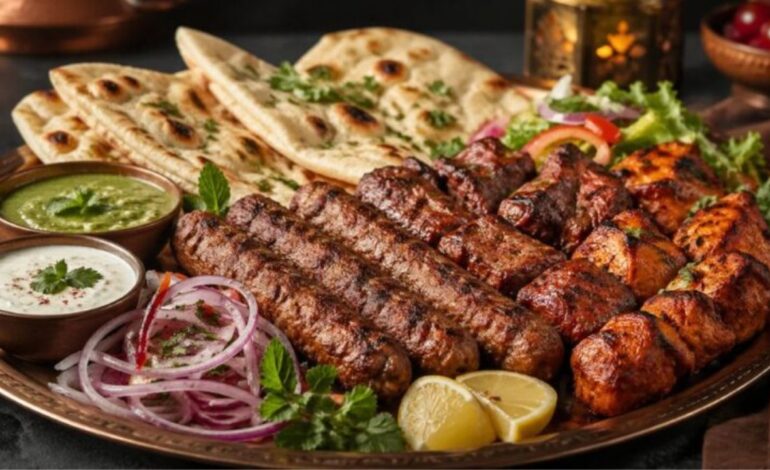
Shish kebab does it differently. Cubes of grilled lamb, chicken or beef marinated on sticks. As the pieces are not consolidated with others, one can easily view their browning and texturing. Shish is typically accompanied by rice, bread and salad, and can be used in wraps too.
Adana kebap is made with minced meat flavored with spices grooved on a large skewer. An assertive flavor, and a texture between burger and sausage, but definitely discernable. In Persia, a similar minced-meat custom exists, generally being called koobideh, which are grilled combination of meat, onion and spices.
Seekh kebabs are popular in South Asian countries. Meat is finely ground in order to mix with spices, herbs and aromatics, developed into varieties of forms around skewers and cooked on strong heat. This can make the smoke smoky, aromatic and slightly spicy. Commonly found next to chicken tikka on skewers in British restaurants.
So, too, have vegetarian kebabs advanced beyond being an after-thought. Halloumi, paneer, peppers, courgette, mushrooms and aubergine are all great options to grill. To be successful they are regulated by equal ideas; correct seasoning, sufficient heat to color and different sauces or salads.
How Kebab plays a significant role in the UK’s food culture.
Kebab is a food that is rare for British cuisine. Quick and quick, familiar yet not boring, customisable yet no hassle order. They can select meat, bread, salad, steaminess and even sauce, making it a meal that is personalized even with its fast-paced service.
Part of the reason for its popularity is also down to migrants who have played a role in the British high street. Family-owned restaurants and takeouts brought regional cuisine traditions and modified services to harmonize with local communities’ lifestyles. Kebab started to form a regular part of the typical British diet, rather than just a novelty. Now featured in takeaways, grill houses, market stalls and new trendy restaurants.
The very best stores know that convenience shouldn’t substitute care. Meat should be hot, properly cooked and freshly sliced. When making salad, it should be crisp while when making bread it should be warm and when making sauce it should not overpower the filling. A food-hygiene rating visible by the customer, a clean counter and transparent information about allergens are also taken into consideration, so that people can choose with confidence.
Although a balance meal can include kebab, it can vary depending on their preparation and its size. Grilled chicken with salad, rice and yoghurt sauce is hardly equal to a big slab of processed meat with the creamy sauce on top and a side of chips. When diners want something lighter, they tend to get their order shish, opt out of the vegetables and fewer sauces and pick one starch item.
The future of the dish in Britain is likely to be more widespread. Some of the cooks are cooking up some old-fashioned regional recipes, and others are trying new types of breads, local plant and meat fillings. Even the very best of ideas are taking into account the most important lesson learnt from the kebab’s success: disciplined heat and equilibrium of ingredients.
Frequently Asked Questions
What does en kebab mean?
It is widely adopted as a search term online in search of an English synonym for kebab. It is not necessarily indicative of a specific or formally documented dish or recipe.
Is döner, the same as shish kebab?
No. Döner is a kebab that is stacked into layers on a vertical rotating spit and cut up into slices. The meat is grilled separately on skewers, which are then assembled to form shish.
But is kebab a vegetarian food?
Yes. Kebab style dishes can be prepared with halloumi, paneer, mushrooms, aubergine and peppers, or with items like plant-based protein round orChanna (Bengali for gram flour) or Oota.
Does kebab have to be healthy?Is Kebab healthy?
It can be a healthy food as long as lean protein, vegetables and moderate sauce are used. A significant difference can be made with the ingredients and serving style.
What would a diner look to to judge a good kebab joint?
Breads and fruits signpost up indoor fresh salad, hot and properly cooked meat, clean kitchen area, clear allergy information and a high food-hygiene rating. It should be a well balanced meal instead of over saucey or greasy.
Conclusion
Aside from its strange name, kebab reveals a much larger story food than is commonly thought. Kebab is not one recipe, it is a family that has been influenced by migration, regional identity and the constant love of cooking over fire. It’s journey onto the British high Street has made it very convenient and familiar however the best versions are still much reliant on craft – careful seasoning, controlled heat, fresh accompaniment and respect for the style it is serving.
It’s more than just quick bite satisfaction – no matter if the diner decides for the smoky shish or Hungarian seekh, spiced with major flavors, or the slices of döner or perhaps a vegetable skewer. It runs the entire gamut between regular meals and a culinary tradition on the move, adapting and uniting.