
Outdoor Broadcasting for Modern Live Events

A championship game, breaking-news scene, music festival, political rally, or community parade can be a breeze when recorded on the camera. On-screen camera shuttles, commentary, instant replays, graphics, and interviews are of good quality. Backed by that sharp presentation is a make-shift production house set up in a facility that is only seldom purpose-built as a TV production house.
Outdoor broadcasting is about this: the people, gear, communications, and decision-making that result from a studio are transported to the scene of the story. The production can cover a national TV channel, a sports league, a streaming service, a university, a corporate business, or an independent media crew.
Modern field production is easier to get to than ever before, but it isn’t just a matter of transporting cameras to the outdoors and hitting live. For a stable broadcast, planning of the locations, power, connection, synchronization, circumspection, and coordinated crews, backup systems, planning for end-fed output into the viewers’ homes, etc., is required.
What Outdoor Broadcasting Really Means
The term ‘outside broadcasting‘ is more widely used in the industry, and it is abbreviated as OB.” Although the name suggests otherwise, this event isn’t necessarily an outdoors one. It can take place in an arena, theatre, convention centre, courtroom, school gym, or any other environment other than a fixed production facility.
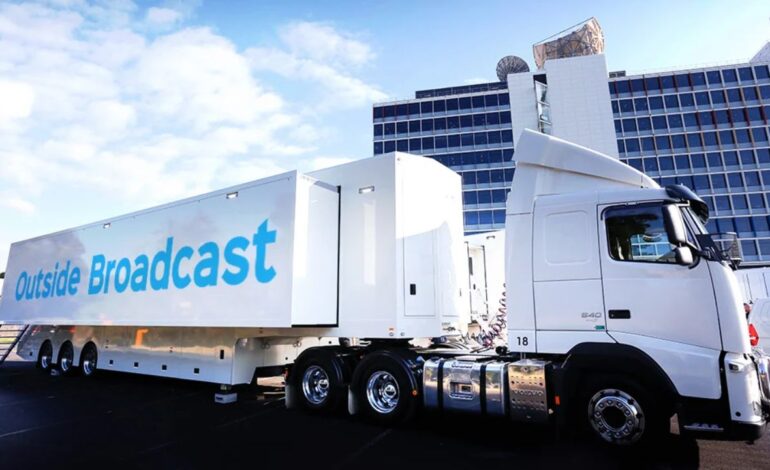
The key characteristic is mobility. Cameras, microphones, switching, monitors, intercoms, graphics, recorders, and transmission tools are brought to the location and configured into a viable production setup. For a large sporting event, a large OB truck can have separate seats for directing, audio, replay, engineering, and graphics. Flypacks are used by smaller productions featuring a variety of equipment containers carried together in one package to be used in a room, tent, trailer, or backstage area.
This flexibility enables the broadcasters to capture events that mayy be impossible to duplicate on a set. Real competition is essential to sports. There is such a thing as not being around whensomething happensn, nd it’s called a news deputy move! Concerts are a function of the energy of the concert hall and the fans. When it comes to events like conferences, religious services, public ceremonies, community events, and so much more, a live view of this in real time provides added value for viewers.
The scale of this can range from two cameras feeding into a small switcher to dozens of cameras with special lenses, replay servers, live stats, and multiple commentary feeds. In all of these, the aim is to transform a live event into a programme thatis easy to observe.
How a Live Field Production Reaches the Viewer
Each production starts with actual cameras and microphones taking the action live. Those sources feed via cable or an approved wireless connection to a production area in the center.
The director determines the camera 1 view, and the technical director switches between camera feeds. Audio engineers have to manthe crowd’sd’sd sound, speech, music, and effects. Graphics operators give names, scores, statistics, captions, clocks, or maps. Replay operators record incoming feeds and get them ready for immediate viewing.
Those roles are kept in sync via private crew communication. Camera operators should be aware of what shot is on the air and what the director’s next shot is. Without letting the audience get distracted, reporters need cues, audio technicians need to know when to open mics, and producers need to give updates without sacrificing the show. That communication network is made possible by an intercom system.
Once the program feed is ready, an encoder gets it ready for delivery. This signal can be sent via fiber, satellite, dedicated internet, or over cellular. In major situations, backup routeways are often used in cases where the selected routes are overloaded. Satellite, fiber, and wireless networks are the big methods for transporting remote-production signals to broadcasters and viewers, according to Ross Video.
No longer just a TV station. A feed can be aired on broadcast TV, cable, a website, a mobile app, a social platform, a subscription service, an in-venue screen, or multiple outlets simultaneously. Producers can also prepare alternate versions, for instance, a version lacking graphics, a version in a different language, or short vertical cuts for cellphone viewing.
Essential Equipment Behind a Reliable Broadcast
Most people are part of a camera, but so too are lenses and equipment. The lens that is required for a camera that is taking a picture of a football field would not be the same size as the lens that is taking a picture of a person in a very close-up situation. From the use of tripods, the shoulder rig, stabilisers, robotic heads, to weather protection, this allows crews to take stable and usable pictures.
It is important to pay the same attention to audio. While viewers can tolerate an inferior picture for a certain amount of time, it becomes quite a chore to follow a show if the dialogue becomes garbled or if comments are omitted. Teams in the field are welcome to use handheld, lavalier, headset, shotgun, and crowd microphones, and direct feeds from a venue soundboard. All sources should have adequate surveillance and mixing.
A production switcher is a combination of the visual sources. Multiview displays enable the crew to monitor cameras, graphicand an playback, as well as the outgoing program,m simultaneously. Video tape and the rest of the recording and replay system are used to store video footage, while routers and converters transfer video signals between storage and between storage and destination.
Transmission chain, in principle, consists of the following components: Encoder, network equipment, and transmission path to the distribution platform. A reliable wired connection can be utilized by a small crew. Mobile teams can be based on “bonded” cellular technology that combines multiple connections. Satellite service might be necessary at remote sites, and dedicated fiber may be offered at major venues.
Power/Cycle shouldn’t be an afterthought. Crews need to determine the electrical load, verify the circuit, ensure the equipment is properly safeguarded from electrical surges, and ensure cables do not cause unsafe running. These small spikes of energy can be protected by batteries or uninterruptible power supplies, but generators can provide some power for larger systems. Practical back-up must be provided for essential equipment such as spare microphones, cables, recorders/recording media, as well as internet/mail routes.
Further equipment protection is required when moving and working. Impact, moisture, dust, and heat can damage cameras, lenses, monitors, and electronics. CP Cases products stress powerfully rugged transport cases and protective camera covers, and provide a glimpse of why equipment protection must be a part of production planning — not an afterthought.
The Challenges That Make Field Production Difficult
A studio is a place to minimize uncertainty; a field location is one to add it. Not only is it the weather, but it’s rain. Weather – wind may have an impact on microphones, camera stability, and temporary structures. Electronics can overheat in hot weather, and batteries may not perform well in cold weather. Systems can also be interrupted by dust, humidity, lightning, or even power disturbances. Despite all the advances made, broadcast equipment is still susceptible to stress and maintenance problems.
Another significant risk is connectivity. That was a speed test done days prior, and it doesn’t mean the test will be the same when thousands of individuals arrive and start using nearby networks. Venue internet could be shared, restricted, or go through security systems that hinder streaming. Under real-world conditions, professional crews test and lay out an alternate route.
Audio may be even more unpredictable than video. Viewers may need to contend with the sounds of PAs, cheering, wind, generators, traffic, reflective walls, etc., near the stage. Correction of these problems through better mike positioning, windscreens, direct feeds, delay matching, and monitoring.
Logistics involves all departments. Permission must be granted to the team to park, unload, run cables, set up cameras, access power, and enter restricted areas. Cable runs can be a trip hazard. The venue may change at the last minute, and the camera positions could be obstructed by fans, security barriers, advertising, etc. Even the most technically correct plan may fail to lead to success if it doesn’t address people and equipment coordination and movement.
The general aspect of live production is that there is little time to recover. Failure in a recorded interview may be repairable, but in the final moments of a game, a broken camera means it’s lost forever. Redundancy, rehearsals, labels, checklists, and clear authority are crucial given that pressure. Professional crews don’t take any risks. They agree to the reaction beforehand in the event that it doesn’t.
How Modern Crews Plan a Smarter Production
The key to a successful production starts with a site survey. The team should check the sight lines for the camera, lighting, sound issues, power, internet access, cable pathways, exposure to the weather conditions, parking, security requirements, crew facilities, and emergency access. Vidori’s planning advice emphasizes power, connectivity, camera positions, audio conditions, load-in routes, and weather considerations, too.
Then the show should be geared towards the audience and not the hardware list. A school game doesn’t require the same set-up as a national championship. The type of production may require more slides and intelligently explicit speaking for a conference, and more attention to audio mixing and exciting camera shots for a concert. Defining the viewing experience will determine what the actual requirement is for cameras, camera operators, graphics, and replay channels and feeds.
Crews then plot the entire signal path. They record the location of the cameras and microphones, where the sources go to the switcher, where the program is recorded, how it is encoded, and which way it goes to viewers. Failure points should be identified in the same plan. Backup internet service may be helpful, but only if the crew is familiar with how to use it when needed.
In addition to this, some directing, graphics, replay, or audio work can be placed out of reach of the venue, with cameras and key personnel back at the venue, which is known as remote integration or REMI production. While this could help to decrease travel, specialists will be required to depend on stable networks and careful latency management across multiple events.
Final rehearsal includes the testing of camera shots, communications, graphics data, audio routing, recording, stream authentication, power backups, and stream failover. Recordings can be highlights, social clips, replays, archives, and on-demand programs after the event. So rather than an end-of-stream value, that’s one live event that becomes a valuable content library.
They tend to talk about the same production out of the and far. The venue doesn’t necessarily need to be outside; it is the more traditional ‘outside broadcasting’ terminology used in the industry.
Frequently Asked Questions
What is the difference between outdoor broadcasting and outside broadcasting?
No Portable Flypacks, Small and Midsize Switchers, computers, encoders, and equipment cases.
Does every remote production need an OB truck?
Don’t assume that any particular part is the direct key to success. Good sound, uninterrupted power, dependable connections, crew communication, and sound-tested backups need to be able to work together.
What matters most in a live field setup?
Absolutely, especially if more than one connection is being bonded. It is still contingent on coverage, congestion, encoding configurations, and backup plans.
Can cellular internet support a professional live broadcast?
Points out factors that can be a problem before the event, including blocked views, poor connections, unsafe cable runs, power, access, and weather.
Why is a site survey necessary?
It reveals blocked views, weak connectivity, unsafe cable routes, limited power, difficult access, and weather exposure before event day.
Conclusion
Creativity and technical discipline go hand in hand to make an outdoor broadcast a success. Geographical planning, communication, signal management, audio quality, protection of equipment, and redundancy keep the event on the air, while cameras capture the event.
Portable systems, remote workflows, and internet distribution have enabled more organisations to broadcast professionally, but the underlying message remains the same: the best broadcast is one that is conceived for where it is going and the audience it is intended for, and potentially where it will fail.